The X2D delivers reliable dual-extrusion at a price that undercuts Bambu's own H2D by more than half. The tradeoff is build volume, not print quality.
What the X2D actually is
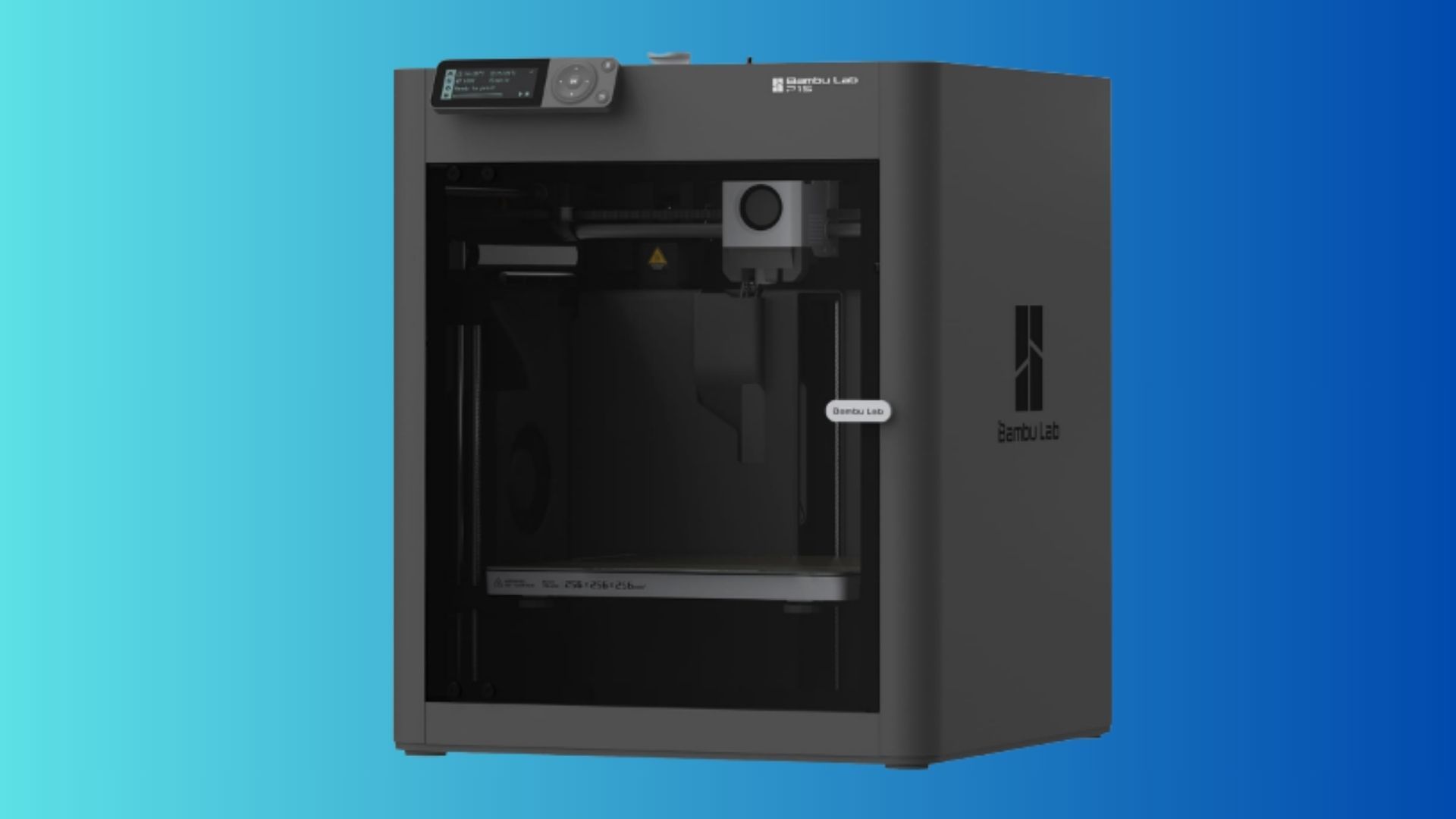
Bambu Lab's X2D sits below the H2D in the lineup, but it is not a budget compromise. It is a focused machine. The defining feature is a dual-nozzle system that prints the part and the support with separate materials. The support nozzle uses a different filament, usually a water-soluble PVA or a breakaway PLA, so it peels away without marring the surface. On steep overhangs and internal channels, that difference is obvious.
The switching mechanism is mechanical. Gears and triggers move the nozzles into place without an extra motor on the toolhead. That keeps the head lighter, which helps at speed. Bambu Lab says the system survived more than one million switches in testing without degradation. In practice, we never had to think about it.
Print quality and materials
The X2D printed ABS, nylon, and TPU as reliably as PLA. Ten temperature sensors track the nozzle, heatbed, and chamber. An airflow sensor keeps the thermal environment steady. The first layer was consistent across materials, even on the standard plate. After a few prints we started using glue just to be safe, but it may not have been necessary.
Three-stage filtration—G3 pre-filter, H12 HEPA, activated carbon—makes the machine tolerable in a living room. That matters because the X2D is designed to run tough materials that smell worse than PLA.
Where the savings come from
The X2D starts at $649, or €629. The Combo with AMS costs $899. That is less than half the price of the H2D. The tradeoff is build volume. In single-nozzle mode the X2D prints 256 x 256 x 260 mm. With both nozzles active, the usable area drops to 235.5 x 256 x 256 mm. If you need a large enclosure and six-color multicolor, the H2C is still the answer. If you need a reliable dual-material workhorse for engineering parts, the X2D is the better value.
Who should buy it
Small print farms, product designers, and anyone who prints functional parts with supports will get the most from the X2D. The dynamic flow calibration compensates for nozzle wear and filament moisture before each print. A PMSM servo motor samples torque and position 20,000 times per second and can detect a jam before it ruins a job. Those are features we usually see on more expensive machines.
The X2D does not win on speed alone. It wins on consistency. After two weeks of daily use, the only complaint was the Mac version of Bambu Studio freezing occasionally. The printer itself was flawless.

Comments (0)
No comments yet. Be the first!
Leave a Comment