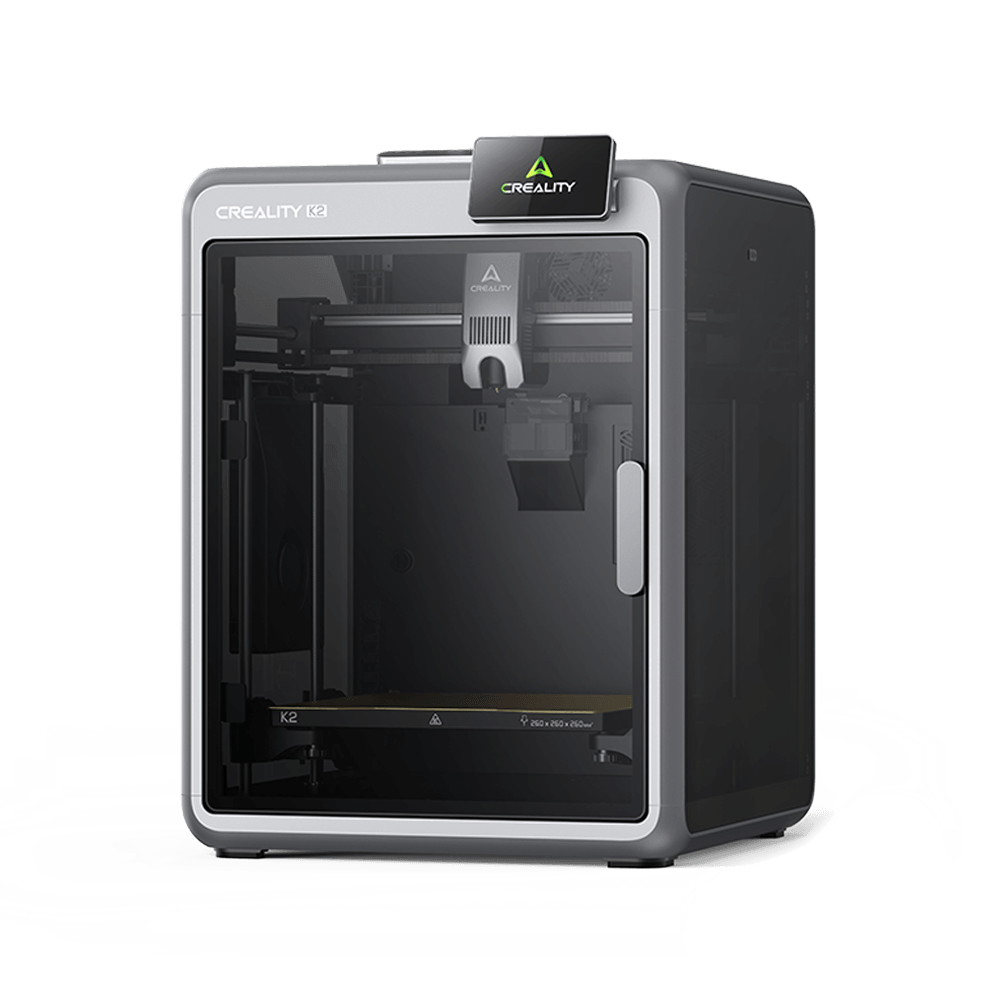
The K2 Pro Combo gives you a 300 mm enclosed build volume and reliable multicolor printing for around 750 euros, but the chamber heater and CFS leave room for improvement.
Creality K2 Pro Combo Review: Big Volume, Honest Compromises
Creality's K2 Pro Combo is the third member of the K2 family and the most practical one for anyone who needs serious build volume without jumping to the K2 Plus. After almost two months of testing, Igor's Lab calls it a convincing machine with good everyday usability. The catch is that a few limitations keep it from feeling fully polished.
What You Get
The headline number is 300 x 300 x 300 mm. That is a useful cube of usable space, enough for helmets, large functional parts, and serious multicolor projects. The Combo includes the CFS multi-material system, a 4.5 kg filament hub that sits beside the printer and feeds up to four colors. The enclosure is fully enclosed with a glass door, and Creality includes an activated carbon exhaust filter.
Networking is flexible: Wi-Fi, Ethernet, and a Fluidd interface reachable on port 4408. The permanently mounted 4-inch touchscreen handles local control, and both Creality Print and OrcaSlicer are officially supported.
Fast Heating, Loud Operation
The K2 Pro heats fast. Igor's Lab measured 225°C at the nozzle in 59 seconds and 55°C on the build plate in 2 minutes and 10 seconds. That matters on a machine this large. The trade-off is noise: 54.8 dB(A) during printing, which is clearly audible. Idle noise is a quiet 33.9 dB(A), but once a print starts, you will know it.
Power draw is reasonable for the size. PLA printing pulled 151 W in the test, while simultaneous heating of nozzle and bed peaked at 977 W. Plan your outlet accordingly.
Chamber Heating Falls Short
The biggest weakness is the chamber heater. Creality advertises active chamber heating up to 60°C, but Igor's Lab measured only 45°C after 30 minutes of chamber-only heating. With the build plate set to 100°C and the chamber heater running, the temperature reached 57°C after 45 minutes. That is close, but not close enough for the most demanding engineering materials. If you need a true 60°C chamber for ABS or PA-CF, you may end up frustrated.
The CFS also lacks filament drying. For a combo system sold as a multicolor workhorse, that is a noticeable omission. Damp filament will ruin multicolor prints, so budget for a separate dryer.
Print Quality and Profiles
Despite the chamber limitation, the actual prints look good. The standard 0.20 mm profile produced clean results, including a fidget spinner where even the 0.15 mm gap parts could be freed. Multicolor prints with the CFS succeeded without major issues.
The reviewer did note some ghosting and minor weaknesses on shallow overhangs. The stock profiles are tuned slightly too aggressively for speed. A 5 percent reduction in outer-wall speed would likely clean that up. Small objects also benefit from a brim; without one, adhesion is mediocre.
Practical Annoyances
The glass door only opens to about 135°, which makes reaching the back of the build plate awkward. There is no door sensor, so the printer will keep running if someone opens it mid-print. The touchscreen is fixed in place and sometimes ignores rapid successive inputs. Optional calibration before each print takes 17 to 18 minutes, which is long enough that most users will skip it once they trust the machine.
Value and Competition
At 750 euros at the time of review, the K2 Pro Combo is priced fairly for what it offers. The obvious comparison is the Bambu Lab H2S with AMS, which costs roughly 1,300 euros. The Bambu has a larger build volume and more refined software, but the price gap is significant. For buyers who want a big enclosed multicolor machine and do not mind tweaking profiles, the K2 Pro Combo saves a lot of money.
The Bottom Line
The Creality K2 Pro Combo is a large, capable printer that gets the important things right: build volume, multicolor support, and slicer compatibility. It also has clear rough edges, especially the underperforming chamber heater, the lack of filament drying, and the noisy operation. If your work fits inside 300 mm and you are comfortable doing some profile tuning, it is one of the better-value large-format combos available. If you need a fully sealed 60°C chamber out of the box, you will need to look elsewhere.
Comments (0)
No comments yet. Be the first!
Leave a Comment