Tripo AI's new preview uses a diffusion approach to build production-ready 3D meshes with native quad topology and much higher polygon budgets.
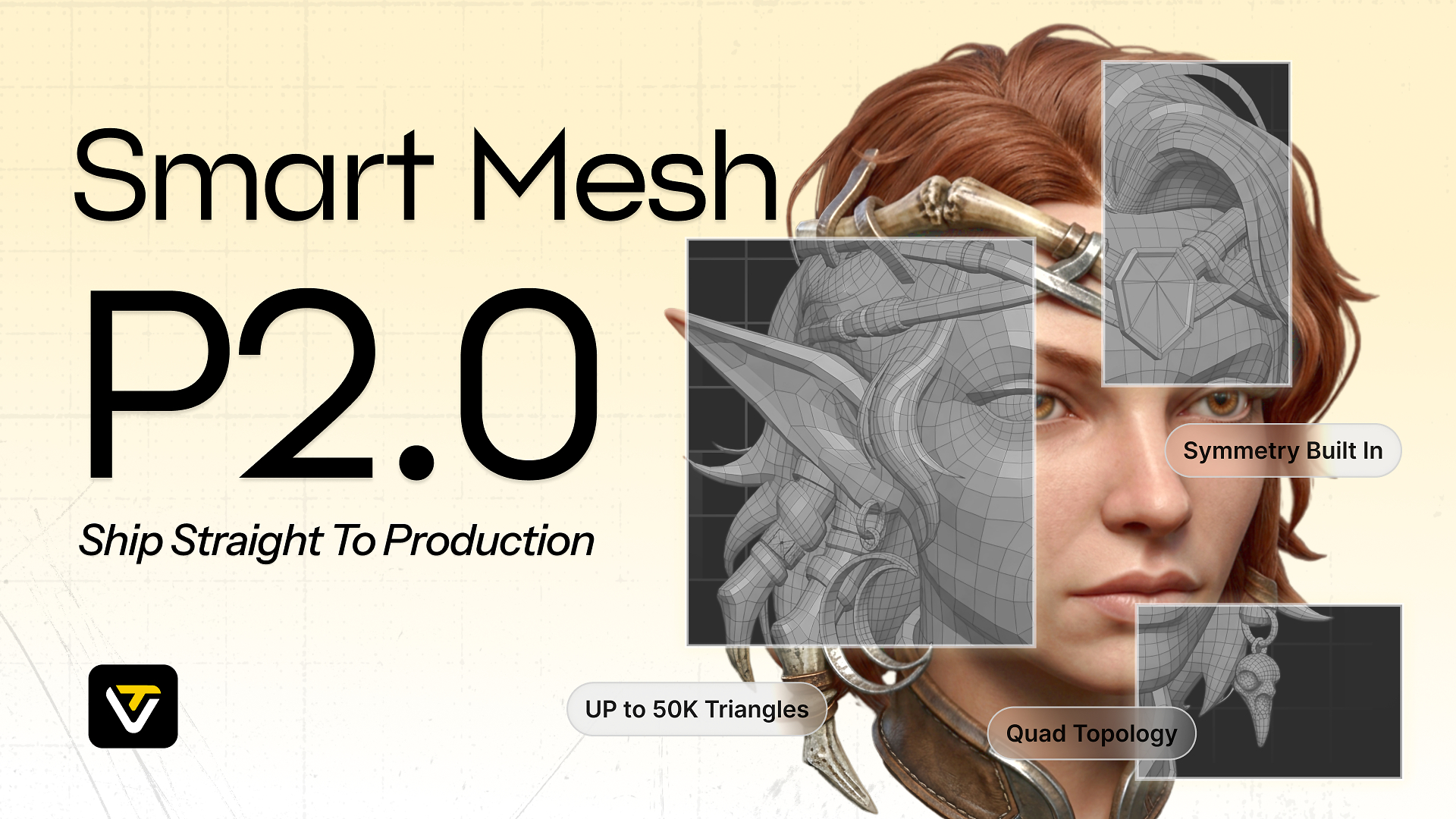
AI-generated 3D models are getting faster and cleaner. Tripo AI released P2.0 Preview on August 20, 2026, and the headline numbers are hard to ignore: up to 50,000 triangles or 25,000 quads per model, generation times measured in seconds, and native quad topology that should need far less cleanup before rigging or animation.
The jump in mesh budget matters. Previous tools often capped outputs at a few thousand polygons, which left artists with a lot of retopology work. Tripo P2.0 Preview pushes triangle counts to 50,000, a figure high enough for hero game assets and detailed mechanical parts without starting from scratch. Quad topology is the bigger deal for production pipelines, because it lets animators rig and deform the mesh without fighting triangulated geometry.
Tripo says the speed gain comes from switching to a diffusion-based approach. Instead of predicting one mesh token at a time, the way a language model spells out a sentence, the system starts from noisy 3D data and refines the whole shape at once. The company argues that meshes have no natural sequence, so forcing them into a token chain creates deformities and wasted computation. Diffusion treats the model as a spatial object, which fits the problem better.
In practice, the workflow is straightforward. You upload an image or enter a prompt, select the Smart Mesh P2.0 Preview option in Tripo Studio, and choose your polygon target. A test run by Fabbaloo on a detailed vintage diving helmet at the maximum 50,000-triangle setting took 71 seconds. That is slower than the best-case marketing numbers, but still faster than many competing services for a usable, printable-quality result.
There are limits. The preview still requires a subscription to download models, and the full P2.0 release is expected to add more stability controls. Even so, the direction is clear: image-to-3D tools are moving from quick previews toward assets that can actually ship in games, animations, and 3D printing workflows.
For designers and makers, P2.0 Preview is worth testing. Tripo is offering two free generations for new users, enough to see whether the mesh quality justifies a subscription. If the topology holds up across a range of shapes, this could become a practical first step for concept models, props, and printable parts.


Comments (0)
No comments yet. Be the first!
Leave a Comment